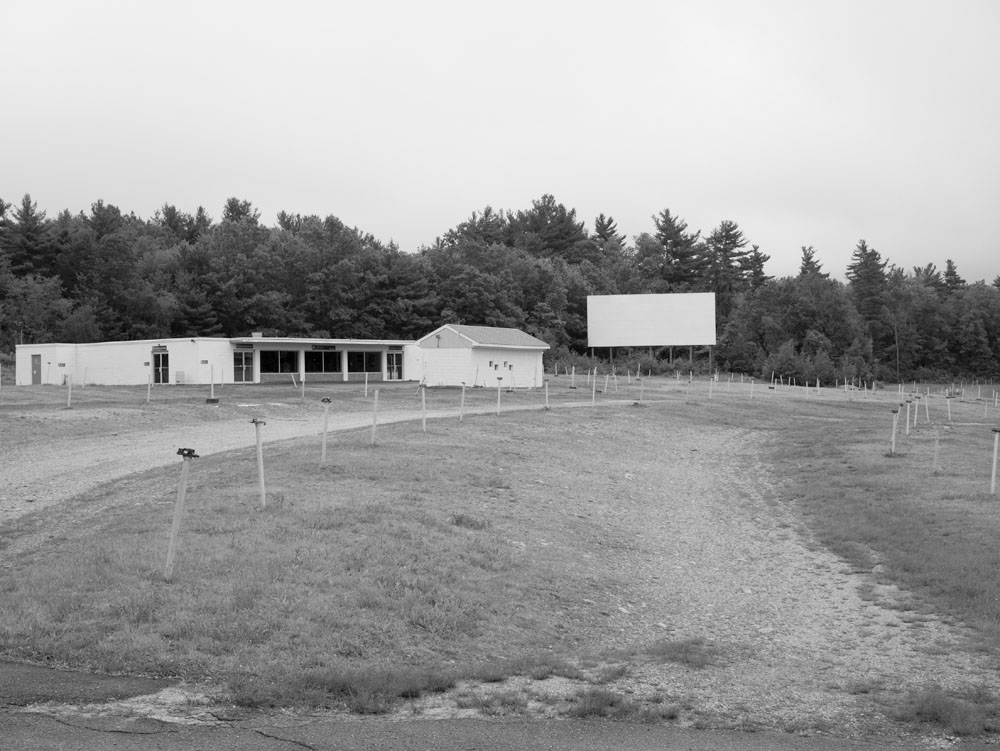
Showing posts with label drive-in theaters. Show all posts

Tuesday, October 16, 2018

Drive-in Theater Presentation in Woodbury, CT

The Warner, Franklin, West Virginia

In case anyone interested might have missed the first announcement—


Presentation:

Drive-in Theaters in the Regional American Landscape

Sponsored by Flanders Nature Center

Tuesday, October 16 at 7:00 PM
Woodbury Public Library, 269 Main Street South, Woodbury, CT 06798

The presentation will feature photographs of about 100 of the 250+ drive-in theaters I’ve photographed over the past twenty years across the country. The talk will give a brief history and timeline of the drive-in, along with extensive stories and anecdotes collected from the scores of theater owners I’ve interviewed in the course of the project.


Wednesday, October 03, 2018

Drive-in Theater Photography Presentation in Two Weeks

"The Pike, Montgomery, Pennsylvania, 2001"

Drive-in Theaters in the Regional American Landscape

Sponsored by Flanders Nature Center

Tuesday, October 16 at 7:00 PM
Woodbury Public Library, 269 Main Street South, Woodbury, CT 06798.

The presentation will feature pictures from about 100 of the 250+ drive-in theaters in 44 states that I’ve photographed over the past twenty years. The talk will give a brief history and timeline of the drive-in, along with stories and anecdotes collected from the scores of theater owners I’ve interviewed in the course of the project. There will be a Q&A session afterwards.

The drive-in theater is an iconic feature of the American landscape. Once there were over 4,000 of them, but now fewer than 400 remain in operation. No two theaters are alike—vernacular architecture on a colossal scale—but they all share common elements and I find it fascinating to see how these elements relate to the different regional landscapes across the country.


Sunday, September 02, 2018

Exhibit Announcement: The American Drive-in Theater


The Camerawork Gallery is presenting an exhibition of selections from my Drive-in Theater project during the month of September. The show went up yesterday, and has pictures of 16 theaters from 12 states, selected from approximately 250 theaters I've photographed since 1998. Next Saturday I'll give a slide presentation with many more theater pictures, a timeline/history of the drive-in, stories and anecdotes from my many interviews with drive-in theater owners and managers, and a Q&A period. Followed by a reception in the gallery space.

Camerawork is the oldest continuously operated fine art photography gallery in the United States, founded in 1970. The exhibition space is located at the Lorenzen Conference Center, Legacy Emanuel Medical Center Campus, 301 N. Graham Street, Portland, Oregon 97227.

Wednesday, June 10, 2015

A Couple More Drive-ins


 Mendon, Massachusetts

Monday evening was the first run of the drive-in project road show, a slideshow/presentation based on my long term project on drive-in theaters all across the US. The presentation at the Langely-Adams Library in Groveland, MA, had a nice crowd in the small conference area. On Tuesday we scouted out two drive-in theaters that I hadn't looked at before. In all the effort to reach theaters thousands of miles away, I've overlooked some of the few that remain here in New England.


Leicester, Massachusetts

Thursday, May 21, 2015

A Presentation


On June 8 I'll be giving a presentation in Groveland, MA, at the Langley-Adams Library. It's based on my long term (since 2001) project photographing drive-in theaters across the United States. The program will run from 6-8 PM. There will be a short introduction to lay out the timeline of the drive-in theaters from 1933 to the present and explain a bit about the business model followed by the 300-plus theaters that are still successful. Next, a slide show with nearly 150 of the theaters, based on the selection and sequencing of the book design for the project, which is nearly complete. We'll have time at the end for a question and answer period.

Wednesday, May 06, 2015

Moving Ahead on the Drive-in Theater Book


We're going full speed ahead again to prepare for fundraising and production on the book version of my 15+ year project photographing drive-in theaters across the country. The design is essentially finished (though "detailing" will be a lot of work) and I've done a completely revised introductory text reflecting important changes that have affected the theater business in the past several years.

A tight estimate for production cost at the printing firm we select is needed before I can design the Kickstarter campaign. So the book design and specs have to be complete enough for accurate estimates. While working on the specs request, I'm also learning the Photoshop Duotone Mode. We'll do the book in tritone or quadtone (not CMYK monochrome) to have the most control over the look of the photographs. To make these, you need to take a file down to 8-bit grayscale, then open a Duotone dialog box. There you specify Pantone inks in addition to black, and you have Curve controls for each ink. There are dozens and dozens of canned duo, tri, and quad-tone choices provided by Adobe, which range from bland to hideous. But by studying the curves in the canned profiles you can get a feel for how the system works (backwards—because it's grayscale the curve top and bottom are reversed from what I'm used to in rgb). One tritone ink set that has nice color offers variations for soft, normal, and contrasty negatives. All three look bad, but the key information is that the variations are done by changing only the curve of the K printer. Compare the mushy "normal" K curve to the harsh chalk and soot treatment meant for a soft original, and you can begin to shape an intermediate curve that gives a good looking "print."

I've been using the preview feature and output to an Epson printer under CMS to get "duotone" proofs that begin to have the look of a direct print made from either my Epson or HP printers.

Saturday, December 13, 2014

Snaps from This Morning's Printing

Woodbury, Connecticut

Marking out the coating area on a sheet. I recall that back when I coated with tubes all the time, I just marked the two ends with a short line, but as I relearn the hand-skill with different materials I find seeing the whole area is helpful.


Not too bad. Platine with mandatory Tween in the solution doesn't seem to care whether you use a glass or acrylic tube. Other papers do.


The Tru-Vu, Delta, Colorado, in the first clearing bath.


The Basin Drive-in, Mount Pleasant, Utah, getting its initial five minute warm water rinse.


Two minutes to go washing the print of The Silver Moon Drive-in, Lakeland, Florida, while a panorama sheet is getting dried with room temperature/humidity air in my old film dryer.


The Jesup, Georgia, theater, into the first clearing bath.


Finishing. After my mandatory walk, spent the afternoon scanning several other 7x17 negatives and outputting digital negatives to print tomorrow.

If anyone is interested, the snaps were made with a Lumix GX7 and 17mm f/1.8 Olympus lens, at ISO 3200, under the compact flouo lamps I've installed in the room, which do not produce enough UV to cause any fogging problems, as standard tubes do.


Friday, December 12, 2014

Printing: Film, Through Digital, to Palladium

Some snaps from the darkroom. This week I've been working with pictures from my American Drive-in Theater project. As mentioned here a couple days ago, some of my 7x17 panoramic shots with expansive western skies benefit greatly from some corrective work in Photoshop/ACR. Yesterday, I made palladium prints from digital negatives, a bit larger than the originals.


Woodbury, Connecticut

I've found that Arches Platine, currently the most reliable paper available for Pt/Pd printing, won't work correctly without using the additive Tween20 in the solution. The combination, however, refuses to accept a perfectly even brush coating. The problem is subtle and doesn't show in most pictures, but 17.5" of perfectly clear California desert sky will show up the tiniest imperfections. So, for the first time in ten years or more, I've switched back to coating the paper with glass tubes or acrylic rods. This presents other problems because Tween makes the solution so runny that it's difficult to keep track of, I'm basically having to learn to coat with a tube all over again.


Prepared sheet and negative placed in the vacuum frame, waiting for the pressure to come up.


Starting the six minute exposure with the vac frame flipped up against the 20x24" UV exposure unit.


The Skyline Drive-in,  Barstow, California, in the first clearing bath.


The Comanche, Buena Vista, Colorado, and the Skyline, draining after final wash, before transfer to drying screens.

Wednesday, December 10, 2014

Working with Scans of Panoramic Negatives

Barstow, California

These are three pivotal pictures from the West and Southwest sections of my American Drive-in Theater project. All done with my 7x17-inch Korona camera with my standard 305mm G-Claron lens. I've had a lot of trouble getting scans of these negatives to do what I want. There's considerable illumination falloff with this lens on this format (vignette) which usually isn't a problem with New England woodland scenes or moody, stormy landscapes. But the enormous skies filled with clean pure light that you see out west made a whole different situation, with the falloff definitely not contributing to the pictures. This was compounded by the fact that, despite the drought, there were usually a few faint wisps of cloud, and because of the drought in the summer of 2012, there were always some pale patches of smoke-haze from the wildfires raging everywhere around. These slight tonal variations interacted badly with the darkening of the picture corners. (Do click on one of pictures to get the larger, isolated view of the pictures.)

Abilene, Texas

Fixing the problem in Photoshop proved annoying, because the effect varied depending on lens aperture and various camera adjustments, making a routine fix impossible. Then I thought about the elliptical gradient tool in Adobe Camera Raw. You can custom shape the ellipse in real time using vector-drawing handles, drawing it custom for each image in just a few seconds. You can change the feather, specify the effect inside or outside the ellipse, and for the effect you have nearly the whole suite of ACR tonal adjustment tools.

Globe, Arizona

So, the procedure is to scan the negative in two sections, orient and merge the two files in Photoshop, then throw the switch to make TIFF files open in ACR instead of PS. Open the file into ACR and fix the falloff along with other basic tonal adjustments, then save the result as a .psd file. Then open the .psd directly into PS to take care of the inevitable dust cleanup (worst part of scanning), then use a Curves adjustment layer and a burn&dodge layer if needed to do the final tonal tweaking. At last, the results I've been looking for from these negatives.

Sunday, November 23, 2014

Drive-in Theater Project

Graham, Texas

After being pushed to the back burner for a while to deal with a lot of other things, my American Drive-in Theater book project is back on the front burner. This week I've been listening to my recordings of conversations with theater owners and managers, made during my 17,000 mile road trip in 2012. Dave Scott, current owner of the Graham Drive-in, arranged for Cloys Trout to stop by the theater he owned and operated for about twenty five years, to talk with me. Dave is trying to keep everything exactly as it was in the concession stand to hold on to the nostalgic atmosphere. The theater opened in 1948. My favorite story Cloys had for me was this one:

“I had one old boy come around the back, he paid his way in, and then walked back there [the projection booth] and said, I need to talk to you. And I said what do you want, and he said I used to sneak in this place and one time, I stole some speakers and I want to know how much that speaker was so I can pay you for it. I said when was this? Oh, about fifteen years ago. I said, well, you just paid for that speaker.”

Monday, October 13, 2014

One More Time

Woodbury, Connecticut

Making a few more prints of The Church and Steep Rock. As it happened, the number of prints I made in each session came out almost perfectly even, on the last day, with the total number of prints ordered, just a little short of 120. A bit too perfect. Not one order has dropped out, all but one are paid for, and I'm assured that the money order is in the mail on that one, so I find I have only two prints left over.

Trouble is, I've got to close the darkroom and make it essentially into a storage pod as we turn the whole contents of the house upside down to clear all perimeter walls for installation of the baseboard heating system to replace the antique—and deceased—steam system. So if anything goes wrong in shipping—and, while the success rate has been excellent in percentage terms, some things have gone wrong in shipping both our first TOP platinum offer and the similar Kickstarter Rewards fulfillment two years ago on the drive-in project—so I need more spare prints.


Since I had to do a short printing session, I decided to pick two of my drive-in theater project pictures, one an 8x10 original and the other a digital capture, run the files through my standard batch action to produce a digital negative file, then output them onto a sheet of 11x17 Pictorico. After the print offer work, I printed the two new negs at my standard time of 4 minutes. They seemed to do quite nicely.

Wednesday, May 07, 2014

Documentary Photography, Emotion, and Projection

The Sunset, Shinnston, West Virginia, 2002

Doing some online research recently, I tripped over a discussion at a photography board that began with a mention of some of my drive-in theater pictures from my website. The discussion took place more than four years ago and I was not aware of it. A fairly long thread developed, which consisted mostly of people recounting fond memories of DI theaters. That’s what usually happens when people see some of these pictures. One individual then went on at some slightly pedantic length about the socio-economic background of the drive-in theater industry, ending with a critique that my pictures were too emotional: histrionically nostalgic.


The Winner, Winner, South Dakota, 2002

That’s quite a bit of projection, there. I literally can’t be nostalgic about the DI because it wasn’t part of my past. I’m the right age, but grew up in the wrong place (they were never, even in the 1950s, thick on the ground twenty miles west of Manhattan) plus, my family almost never went to movies anyway. My experience began when I became interested in them as a subject for documentary photography, starting about 15 years ago. My connection to them is entirely in that extended present tense. I suppose I could manage to come up with some metaphorical nostalgia based on all that I’ve learned about the subject, but it’s not a conscious goal.

Documentary photography for me is observational, but never objective, neutral, or unbiased. No art form is objective. I think good documentary photographs result when the photographer makes prints (including now online, eBook, iPad, etc. presentations) that work as a bridge, that facilitate a perceptive viewer to move through the print to an emotional connection with the subject. Good photographs build that bridge, but the actual emotion comes from the viewer, and the viewer’s relation to the subject matter.


The Jesup, Jesup, Georgia, 2012

Let’s say someone looking at these pictures, “grew up at the drive-in,” (a phrase I hear a lot) or simply has fond memories of childhood family outings, or teenage dating with an unaccustomed degree of privacy. If there’s an emotional reaction, the emotion may well be nostalgic. She might decide that I’m intentionally making sentimental or nostalgic pictures.

I can imagine another possible viewer, let’s say a Fundamentalist preacher, who was raised believing that the drive-in theater was a terrible blot on society, an immoral “passion pit,” leading youth so astray that the saloon and the pool hall look like garden parties in comparison. If he looks closely at the pictures, he might establish an emotional connection, but it may be one of revulsion and opprobrium. He might accuse me of immorally promoting these dens of iniquity with my pictures.


The Starlite, Christianburg, Virginia, 2003

In a related vein, I’ve never referred to this project as being about “Abandoned Drive-in Theaters,” (or Dead, or Derelict, or Dark, etc). Yet, people almost always use one of those terms to refer to it. In fact, at least 75% of the theaters shown in my older web gallery presentation, and more like 90% of the 107 theaters shot in 2012, are fully operational, or at least were at the time I shot them. Seems like projection again, overlaying the viewer’s personal experience on the pictures. The things is, 90% of the theaters scattered across the country at the heyday, around 1960, are gone. Hundreds are still operating, but, out of sight, out of mind. Despite the fact that quite a few pictures in the project show evening activities, and that a lot of the theaters shown in their daytime landscape settings are gleaming white and in perfect repair, a lot of viewers just skip over those—maybe, "they don’t fit in”—and say something like, “I used to love the drive-in, too bad they’re all gone.”


The Boulevard, Kansas City, Kansas, 2012

As I design the book layout, a couple things I’m planning are that each plate will be identified with the name and location of the theater, along with the date the picture was shot. Also, endnotes will, wherever possible give brief, historical stats on each theater, including whether it’s still operational at the time of publication.


Wednesday, April 16, 2014

Another Dramatic Sky

Wisconsin Dells, Wisconsin

More scanning, this one from a 2011 8x10-inch negative. I'd been thinking of using a 7x17 panoramic shot I made of this theater, but then realized that with the theater name "Big Sky," I really should go with this wide-angle 8x10 shot that includes much more of that big Wisconsin sky than the skinny pan shot.

The Warwick

Warwick, New York

Working on the design of the drive-in theater book yesterday, I found that the scan of this 7x17 inch negative was made on my Microtek 9800, back in 2009, when the scanner was failing. Long stripes across the sky when you look closely. So one of my tasks this morning has been to locate the negative, made in 2002, to scan it in two sections on my Epson V750. After merging the two scans in Photoshop I've got a nice rendition of the dramatic light and clouds on the late winter morning I shot it. More good news, a quick search online tells me the Warwick is up and running for the season, having managed to make the expensive conversion to digital projection.

As always, click on the image and you'll get a larger, clearer view of the picture. Don't forget there's still the April print offer going on, details at the top of the right-hand sidebar.

Sunday, September 15, 2013

More of the Winners

Honor, Michigan

Traveling at the end of the week, and recovering, yesterday, I didn't keep up with the Honda drive-in theater promotion, but this is my shot of The Cherry Bowl, which was their second winner. I made this with my 8x10 in September of 2011.

Graham, Texas

The Graham theater, another 8x10 shot, from June of 2012

The McHenry, Honda's fourth winner, is new to me, not in my collection. I don't think it appears in the main online theater lists I've used for my research. Neither were the two theaters I photographed up in New Hampshire last week. It was never my goal simply to catalog the theaters by shooting every single one, but it's a little annoying to find there are theaters that my research never turned up. The campaign must be making good publicity for Honda because they announced that they will award four additional digital projection systems, for a total of nine.

Newburgh, Oregon

The fifth contest winner. My camera position was out in the shoulder of a busy four-lane highway, so I did this one with digital capture, hand-held, late June, 2012.

Friday, September 13, 2013

The Randall Drive-in Theater

Randolf/Bethel, Vermont

Amazingly, the very heavy weather I was in all day, moving around from New Hampshire down into central Vermont, opened up into luminous open light with a dramatic sky and no rain, just as I arrived at the theater. I quickly set up the 7x17" Korona in case the downpours came back, and made two slightly different views. Then a lot of coverage with digital capture.

A really productive two day expedition, but exhausting. Got back in about 8:00 PM.

Wednesday, September 11, 2013

Saved: The Saco Drive-in Theater

Saco, Maine

The "Save the Drive-in" promotional campaign by Honda has begun to announce the winners of five digital projection systems, one a day beginning today. The Saco theater is the first to be announced. This is a picture I made in 2003 of the back of the screen tower from the entryway. Given its condition ten years ago, it's nice to know they held out long enough to be the first winners in the projector contest. Now I'll be hoping some of my favorite theaters are among the other four big winners.

Sunday, September 08, 2013

Fairlee Drive-in Theater

Fairlee, Vermont

This is from digital capture—the large format film is still in the holders—but it's from the same position as the 7x17" shot. This is going to contrast nicely with several theaters in the Pacific Northwest, surrounded by very different-looking evergreens.

On Location

Fairlee, Vermont

We had several things to do on a quick overnight excursion to Vermont and New Hampshire, including a stop at The Fairlee Drive-in Theater Saturday morning. I'd somehow not yet managed to include it in the giant DI project. For a behind the scenes look, Tina took a series of snaps as I worked. This is setting up the 7x17-inch Korona Panoramic View Camera (that's its official name, from a metal nameplate on the front panel).


That's the target.


Lining everything up. Setting the camera in "exactly the right place" is always key, but with the theaters tiny differences in camera position have a big effect on the pattern and intersections/mergers of all the speaker poles in the field, leading to the screen.


Measure the shadow values with a 1° spot meter. This is a second, somewhat closer camera position, using the 8x10" Deardorff.


The sun is out with a light veil of thin cloud. 1/2 second @ f/64.


Digital capture of details around the theater, waiting for the light to be right for the 8x10 shot.


Making the 8x10 exposures.

Wednesday, July 17, 2013

Slide Show at msn.com

The Owen Drive-in Theater, Seymour, Missouri

Over at msn.com they've put up a slideshow drawn from my American Drive-in Theater project. Some of the pictures have appeared here, but some others will be unfamiliar even to regular WP visitors.